
Image: The Ultimate Bird Drawing Throwdown Showdown Graphic featuring images of David Sibley and H. Jon Benjamin

Join BirdNote tomorrow, November 30th!

Illustrator David Sibley and actor H. Jon Benjamin will face off in the bird illustration battle of the century during BirdNote's Year-end Celebration and Auction!
RESERVE YOUR SPOT

Shows With Contributions by Frances Wood

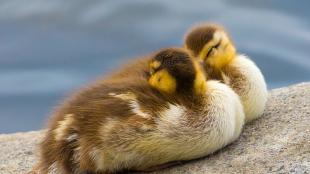
Two Mallard ducklings snoozing on a cement bank by the water, their beaks tucked beneath their wings

Where Birds Sleep

All birds need to sleep — or at least snooze — sometime during each 24-hour period. And most sleep at night. A bird, like a Mallard duckling, may turn its head around and warm its beak under its shoulder-feathers. Songbirds find a protected perch, sheltered from rain and nighttime…
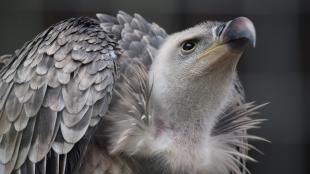
Ruppell's Griffon Vulture

How High Do Birds Fly?

For the majority of the year, most birds stay under 500 feet. During migration, many species fly at 2,000 to 5,000 feet or above, using prevailing winds to assist them. And some birds go even higher! In 1973, a Rüppell’s Griffon set the world record by soaring to 37,000 feet.
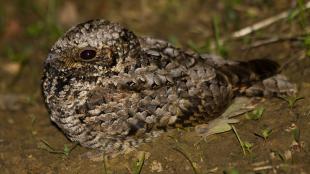
Common Poorwill, male

Birds That Say Their Own Names

Some birds, such as the Northern Bobwhite, get their name from their songs or vocalizations: "Bobwhite! Bobwhite!" The Killdeer is another bird named for its song: "Kill-dee, kill-dee, kill-dee." There are others. "Poorwill, poorwill, poorwill," says this Common Poorwill. This bird is the…
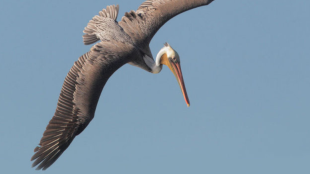
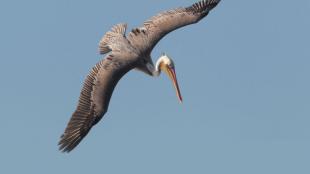
Un pelícano café lanzando en picada

Así se sumergen los pelícanos

Los pelícanos café ( Pelecanus occidentalis) vuelan pegaditos a la superficie del agua. Hacen círculos en lo alto, y luego se sumergen en clavado, con la cabeza por delante, para atrapar peces. Pero, ¿eso no los lastima? Varias adaptaciones protegen a los pelícanos mientras se sumergen…
Brown Pelican soaring against a blue sky

How Brown Pelicans Dive

Brown Pelicans fly just above the surface of the water. They circle high, then diving headfirst, plunge under water to catch fish. But doesn't that hurt? Several adaptations protect pelicans as they dive. First, they have air sacs beneath the skin on their breasts, which act as cushions…
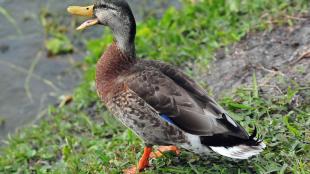
Male Mallard duck in eclipse plumage

Male Mallards Disappear

By late summer, the male Mallard’s need for fancy feathers to attract the females has passed. These birds have molted, and their bright feathers are replaced with mottled brown ones. Subdued colors help camouflage the male ducks, protecting them from predators. Come fall, the male Mallards…
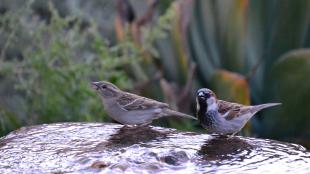
Pair of House Sparrows on the edge of a water-filled birdbath

House Sparrow Pool Party

Social, chatty, ubiquitous, the House Sparrow has adapted to living in cities, suburbs, and rural areas. Like most birds, these sparrows enjoy a daily bath. Set out a birdbath, and you can watch them chatter, splash, and shake, sending droplets flying. Birds like very shallow water; an…
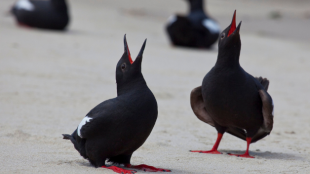
Two Pigeon Guillemots appear to call out to each other with their mouths open skyward on a beach. The birds are almost entirely black except for their bright red feet & mouths, and a large white patch on each wing.

Pigeon Guillemots Have Fun

Although many seabirds utter groans and croaks, the Pigeon Guillemot produces a lovely series of trills and whistles. As part of their courtship, they fly side by side in large circles and loops, a perfectly synchronized flying act. These guillemots do not breed until they are between…
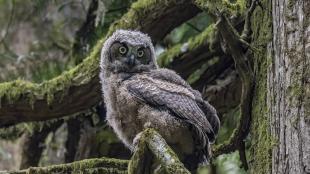
A Great Horned Owl fledgling perched on a mossy branch

How Nestlings Leave the Nest

Young birds leave their nests in different ways. Some shuffle tentatively along the nearest branch and practice flapping their wings, while others take the "big leap." Which path they take depends upon their species and the location of the nest. Young Great Horned Owls clamber out of the…
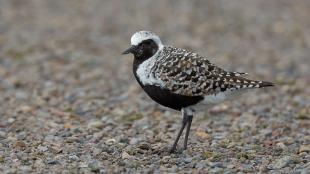
A Black-Bellied Plover shorebird stands on pebbly bare ground

Black-bellied Plover, Arctic Nester

In the Arctic National Wildlife Refuge, June days offer almost continuous daylight to breeding birds, including this Black-bellied Plover. At this high latitude, Black-bellied Plovers can complete their breeding cycle in a month and a half. Not long after the summer solstice, the adults…