
Image: The Ultimate Bird Drawing Throwdown Showdown Graphic featuring images of David Sibley and H. Jon Benjamin

Join BirdNote tomorrow, November 30th!

Illustrator David Sibley and actor H. Jon Benjamin will face off in the bird illustration battle of the century during BirdNote's Year-end Celebration and Auction!
RESERVE YOUR SPOT

Shows With Contributions by Bob Sundstrom

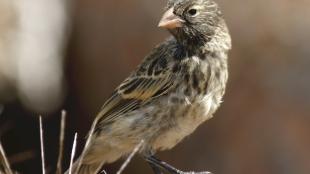
Medium Ground Finch

Rapid Evolution in the Galápagos Islands

Scientists have long thought that new species took a very long time to emerge. This thinking has now changed dramatically. On an island in the Galápagos, researchers Rosemary and Peter Grant discovered that a hybrid union of two distinct species of finch produced descendants different from…
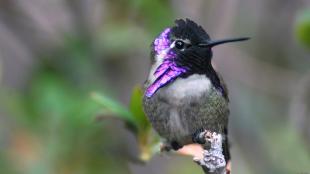
Costa's Hummingbird

Spring Rain Refreshes a Desert

Springtime in the Anza-Borrego Desert State Park in southeastern California. Cacti and wildflowers glisten with raindrops, and birds begin to sing. A House Finch, a Bewick's Wren, a Cactus Wren, a Mourning Dove, and this Costa's Hummingbird all add their sounds. The soundscapes featured in…
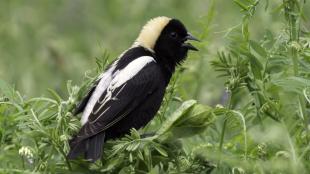
Bobolink

The Bobolink's Remarkable Journey

As Bobolinks return to North America from the tropics each spring, they have good reason to sing with joy. The two-ounce birds have completed one of the longest migrations of any songbird: roughly 6,000 miles.
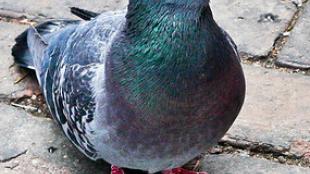
Pigeon on cobblestone street

Pigeons Love Cities - But We Loved Them First

Though some might see them as winged rats in today’s cities, pigeons have a long-standing bond with people -- especially in our urban environment. From Mesopotamia, 7000 years ago, to the urban skyscrapers of today, pigeons have been a constant. They’ve served as meat and sacrifices…
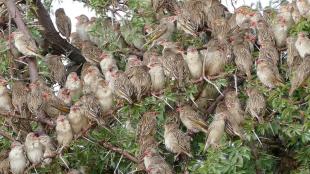
A flock of Red-billed Quelea densely bunched on leafy branches

The World's Most Abundant Bird

An estimated 1.5 billion Red-billed Quelea live in Africa today, making them the most abundant of all wild birds. The sparrow-sized Red-billed Quelea flock together in groups so large, from a distance they appear to be clouds of smoke. Red-billed Quelea are in the weaver family and create…
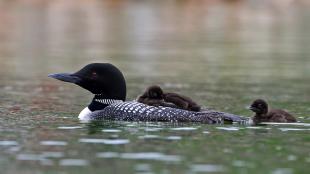
Common Loon with chicks

Birds Move from Fresh to Salt Water

To hear a Common Loon in the wild during summer, you’ll need to find a northern, freshwater lake where a pair is nesting. But to find that same Common Loon in winter, you’ll likely need to look on a saltwater bay. This shift from fresh to salt water would kill most animals. But loons —…
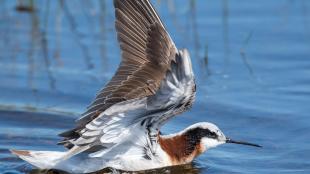
Wilson's Phalarope

Wilson's Phalarope

If any bird is an anomaly, it's the Wilson's Phalarope. In a birdbook, Wilson's Phalaropes are found among the sandpipers. But they forage while swimming. Spinning like tops, they create an upwelling, pulling food to the surface. The breeding of Wilson's Phalaropes is anomalous, too…
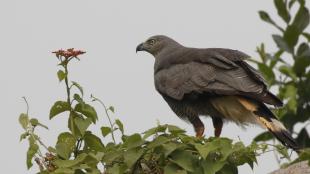
Crane Hawk perched in tree top

Double-jointed Hawks and Convergent Evolution

Crane Hawks of Central and South America and African Harrier-Hawks both have legs that bend forward and backward. Each bird’s wonderfully peculiar leg adaptation is completely original - it evolved all on its own - even though the end result is the same. Scientists call this convergent…
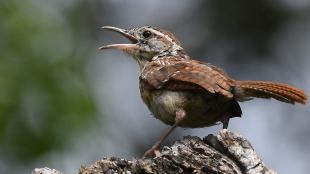
A small brown bird with a white "eyebrow" streak and its beak open stands on a stump.

Voices and Vocabularies - How Birds Sing So Loudly

When a Carolina Wren like this one sings, something remarkable happens. These birds can sing so loudly that you almost have to shout to be heard over their songs! How can a bird like a Carolina Wren – at just 5½ inches long and weighing only as much as four nickels – produce so much sound…
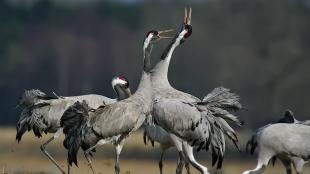
Grey-feathered Common Cranes standing in a field - some have their black and white heads raised and their beaks open.

Cranes' Voices Across the Globe

There are fifteen species of cranes across the globe, found everywhere but Antarctica and South America. During the winter, cranes forage and rest together by the thousands. Listen in to the voices of cranes from all over the world. Nothing evokes the spirit of the wild like the voices of…