
Join BirdNote tomorrow, November 30th!
Illustrator David Sibley and actor H. Jon Benjamin will face off in the bird illustration battle of the century during BirdNote's Year-end Celebration and Auction!
Birdsong and Speech with Dr. Erich Jarvis
Bring Birds Back Season 7: Episode 4

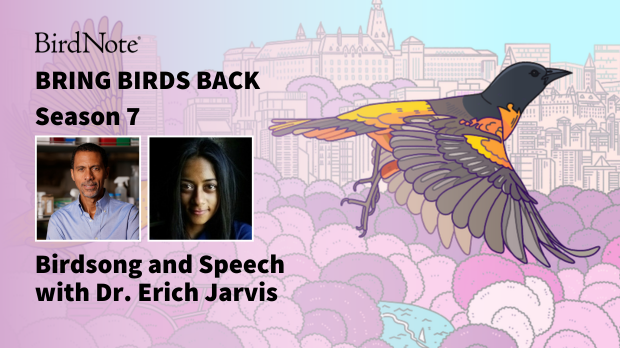
Host Anika Hazra speaks with tenured professor and leading voice in neuroscience, Dr. Erich Jarvis! Erich, who has spent decades researching the neural biological connections between mammals and birds, shares his research that indicates some birds are ancestrally connected to humans through speech! Detailing his work with song-learning birds and humans, he explains the importance of these discoveries, especially regarding speech deficits and disorders. Later, as a longtime NIH partner, Erich gets honest about the setbacks and challenges he and his colleagues are facing. Press play on this important episode today!
Want more Bring Birds Back? Follow us on your favorite podcast app and on Instagram @BringBirdsBack!
And for more information about how to get involved in our From Love to Action campaign, visit this page.
BirdNote is a nonprofit. Your tax-deductible gift makes these shows possible.
Bring Birds Back Season 7 is sponsored by the Cornell Lab of Ornithology and Bird Academy.
[PRE-ROLL]
[Bring Birds Back Stinger]
Anika Hazra: BirdNote Presents.
[music starts]
This is Bring Birds Back and I’m Anika Hazra.
So, you know how we typically talk about our feathered friends? Well, it turns out, they’re also our feathered family! …verrrry distant genetic cousins — neurologically speaking! On today’s episode, we’re diving deep into new territory: evolution and the brain! The last common ancestor between mammals and birds lived around 300 million years ago. And while we’ve been evolving on separate paths ever since, scientists are now discovering that a human’s ability to talk and a bird’s ability to sing share very similar origins.
Dr. Erich Jarvis, a leading neurobiologist in his field today, walks us through the evolutionary ancestral link between songbirds… and humans. Erich has been studying the connection between birds and humans for over 30 years. And much of his own work is a continuum of the scientists that came before him. Scientists that have greatly benefited from the National Institute of Health, including his own work.
So, in our conversation about his team’s fascinating findings, we’ll also talk about what’s threatening his work and so many others today. And what we can all do to make sure we’re protecting our futures by protecting our scientists. But first, let’s chat about some birds!
[In conversation] I appreciate your time. So why don't we start with you introducing yourself and letting us know, um, just briefly what kind of research you work on.
Dr. Erich Jarvis: So Erich Jarvis, professor at Rockefeller University in New York. And also investigator at the Howard Hughes Medical Institute in Chevy Chase, Maryland. I study the brains of species that learn how to imitate sounds, like songbirds, parrots, hummingbirds amongst birds and humans, dolphins amongst the mammals. And I study the genetics of those traits. That is the genes that are responsible for setting up those brain circuits.
Anika: Erich is also the leading name and head scientist of The Jarvis Lab, a research center at Rockefeller University that uniquely houses three different labs and locations: The Laboratory of Neurogenetics of Language, which focuses on neuroscience and the Vertebrate Genome Lab dedicated to new technologies and genome assembly are both in New York City, while the Field Research Center, in upstate New York, is concentrated on studying wild animals and transgenic birds.
Erich: All three different spaces have different roles, but they interact. So studying the genomics of brain and language, and studying them in animals in the wild vocalizing, you can imagine how you utilize all three of those spaces.
Anika: So clearly, a really large focus of your research is on birds and their vocal learning abilities. So, as a bird podcast, we have to ask, what was the inspiration behind working with birds to study vocal learning?
Erich: Yeah. So I got into vocal learning [a] long time ago when I was at Rockefeller as a student. I wanted to study the genetics of learning and memory when I got to graduate school and a lot of my classmates wanted to as well. It was a big deal at the time in the 1990s. A lot of us were trying to figure out what learning and memory system to choose that's gonna be interesting. And I happened upon this lab at Rockefeller's Fernando Nottebohm Lab studying song birds, learning how to imitate sounds, right? And that really got me excited because I thought not only will I be studying learning, but I'll be studying learning that's relevant to human speech and language.
Sort of knock out two major goals, understand principles of learning and memory and in the context of spoken language. There are only a few animal groups that can do that, and the best animal model studies for them was song birds that they were studying at the time in the lab, zebra finches and canaries. Whales and dolphins were too big, right? Uh, parrots didn't seem as easy to study at that time, and we didn't know about bats until a few years later. So songbirds became the model for human speech, even though it's independently evolved. And, and that's the main reason why I like songbirds because they can imitate.
Anika: Would you say you have a favorite songbird?
Erich: Yeah, I would say that crows are my favorite. Many people don't realize crows are songbirds, but they are. They don't actually have a loud song that many other birds sing. They can sing a variable song, but very quietly under the bushes, at least that's what one of my mentors, Peter Marler, told me. But, the one used for neuroscience research the most is the zebra finch. It's originally from Australia and it's like a sparrow-sized bird that we and many other people breed in the laboratory for study. So I won't say they're my favorite, but they're the most convenient to study.
Anika: Would you say, since you started working with birds in your research, you may have developed a connection with birds outside of that context? Have you become a birder?
Erich: Yeah, when I first started as a graduate student studying songbirds, I had my Sibley bird guide and I would go out with binoculars to the field station, upstate New York. Or to some field site in Brazil where we were studying hummingbirds and had my little checklist of birds. But I became less of a field bird checker because, although I was intrigued by the diversity of the species I was seeing out there, I needed to focus on studying a few species that represent many others, to try to understand the basic principles of vocal learning and also to dig deeper into mechanisms. You want to not to spread yourself out across many species too quickly.
Anika: Okay. So speaking of digging deeper into mechanisms, let's start talking about some specific studies you were involved with. So in 2014, you were involved in a study that concluded that song-learning birds and humans share independently evolved similarities in brain pathways for vocal learning that are essential for song and speech and are not found in most other species. So can you translate this conclusion for us into more general terms?
Erich: Yes. Um, for, for many years before that study, many labs, including my own, would say that they're studying songbirds as a model for human speech. But most of those labs weren't making the direct connections. They weren't looking in human brains for the parallels, if it existed at all, for song learning.
So we knew there were a lot of parallels in how songbirds and humans acquired their learned vocalizations, their learned repertoires through critical periods. And going through a babbling phase before that, like children babble and songbirds sing subsongs.
And there was some preliminary data out there on the connectivity in the brain of shared connectivity, let's say, of cortical regions in the brain controlling the muscles that produce the sounds for vocalization. However, we didn't know of any genetic relationships and we didn't know the full extent of the parallels or nots, you know, between humans and songbirds. So in that 2014 study you asked me about, one of my graduate students, Andreas Pfenning and postdoc Osceola Whitney, what we did is, we had the genome sequence of a larger consortium I was leading of many different bird species, including songbirds.
And with that genomic information, we were able to look at and measure the regulation of certain genes in the brains of songbirds and humans. And when I say regulation, I mean genes whose products, like proteins, are turned up or turned down compared to the rest of the brain.
Anika: Erich is highlighting a 2014 study he and his colleagues published in the journal Science. By comparing the brains of songbirds to the brains of humans, they were searching to find if the genomic sequences or simply the unique DNA pattern, found in particular neural areas of each, were similar to the other. In other words, do humans and birds use similar genes in areas of the brain related to speech?
Erich: And the answer was yes. At that time we found a little over a hundred genes that were specialized in their regulation in the same way in songbirds and humans, and also parrots and hummingbirds, the other vocal learning bird groups. And not just between the distant mammal and [the] distant bird, but distant bird vocal learning bird groups. And with that information, we were able to show and conclude that certain areas of the songbird brain involved in song learning are convergently evolved to become similar to certain areas of the human brain involved in speech.
Anika: To be “convergently evolved” is to say that two different species, such as zebra finches and humans, have developed in similar ways, despite having split from a common ancestor over 300 million years ago[12]. Though independent of each other ancestrally, they formed similar traits, genes and behaviors from similar environmental needs. Erich and his team not only theorize that song-learning birds developed traits essential for song and speech like humans did, they also believe that these distinct animal groups share similar genetics.
Erich: And we were able to do a one-to-one mapping of those brain areas between songbirds and humans that led us to, uh, say that, yes – not only the behavior and the brain connectivity, but the underlying genetics has converged between the vocal learning birds and humans.
Anika: You mentioned among the songbirds that were involved in the study, parrots and hummingbirds. So just to clarify for myself: they're separate from songbirds?
Erich: They're separate from songbirds. They're not a songbird.
Anika: Okay.
Erich: Depending on how you slice the pie, there are roughly 40 orders of birds. Okay? One order we call galloanseriform birds, those are like chickens and ducks and goose and turkeys, right? Another is like the penguins; the emperor penguin, the King Penguin, right? Well, just like you have those different groups, you have 3 of those 40 groups are the vocal learners: the songbirds, the parrots, and the hummingbirds. And songbirds, I gave two examples before: the crows and the zebra finch, but you have starlings, you have house finches, you have canaries. Those are all songbirds.
The parrots, you have African Greys, you have the Amazon parrots. A species of parrots that we profiled at that time, they're called Budgerigars. And these are basically, uh, the parakeets that many people buy in pet shops. Parakeets basically means a small parrot, alright? A parakeet is a parrot. And later on we studied the brains of other parrot species like African Grey Parrots and, uh, cockatoos. And we found the same brain areas in them as well with some of the same gene expression specializations. They were just bigger in some species that imitate sounds better than other parrots.
And hummingbirds, many people don't understand the different species of hummingbirds. But the two that come to the United States the most is the Ruby-throated Hummingbird on the East Coast. Alright? And the Anna's Hummingbird on the West Coast. And uh, we found similar brain regions in them as well. And what that meant: parrots, songbirds, and hummingbirds, each independently evolved their vocal learning abilities, just like humans evolved it independently of those three bird groups. So in the last 65 million years, three bird groups came up with an independent solution to the vocal learning ability, but using the same genes.
Anika: Okay. Well, thank you for that so just to go back to study, could you elaborate on why you think the findings of that study are significant?
Erich: Well, once we found that there were similarities in human speech brain regions with these vocal learning birds, that meant that you can more readily translate findings from songbirds and parrots and hummingbirds to humans. Even though they convergently evolved separate from a common ancestor, the fact that they evolved to a similar solution meant that translation of findings, whether it's basic findings of how the basic biology works or translation for health-related things like for diseases of speech, you can translate them back and forth. I don't want to uh, give people the impression that the songbird brain is identical to humans. There is an overall structural difference in the bird brain and the human brain. Yet, the genes and the type of connections are similar.
Anika: Okay, let's move on to another study on convergent gene expression that you were involved in, in 2022. So this study concluded that vocal learning is a skilled motor behavior observed in several mammalian and avian species, and is critical for human speech. So, another translation please?
Erich: Yes. Okay. Well, in that 2022 study that gave us those results, also gave us more confidence about the vocal learning pathway.
Anika: That research was posted to the preprint server BioRxiv [“bio-archive”] — we’ll refer to it as “the 2022 study” in this episode. It focused on the convergent gene expression of vocal motor pathways in songbirds and humans. Or, in other words, whether or not songbirds and humans also use the same neural pathways and genes to produce learned sounds, despite evolving separately.
Erich: We found that the brain areas for learning how to imitate sounds or the ones that really make it special for our specialized ability of speech, is embedded in a motor pathway, a brain pathway that controls body movements. And we think particularly learning how to move, not just innate movements, but learned movements. And we found that the songbird, parrot and hummingbird and human brain pathways were embedded in this, let's call it an ancient motor pathway that exists in all vertebrates.
And so that led us to propose a hypothesis that the brain pathways for spoken language in us [and] song in songbirds evolved by a whole brain pathway duplication of this ancient motor learning pathway that controls learning how to move different body parts. Instead of now controlling the body parts of our organism (us), and birds, it's controlling the larynx in mammals and the syrinx in birds, the muscle groups that control sound.
Anika: The team’s hypothesis is that an ancient common ancestor between mammals and birds passed down these motor pathways that make it possible for all of us to move our bodies. However, they believe only a small group – like humans and songbirds – evolved new traits that adapt that original pathway to control how we make sounds.
Erich: And so, um, when you look at the brain pathways for processing speech, like you're listening to me right now as I speak. That listening, you're understanding my words, you're understanding the meaning of my words, you're understanding the syntax, the whole sequences of words I'm making; we're arguing that is less specialized to humans. We're not saying it isn't, but it's less specialized than the motor part for speaking. And this is why I think dogs can understand not only the word “sit” in English or “siéntese” in Spanish, “hinsetzen” in German or “osuwatte" in Japanese, right? A dog wasn't born to understand human speech sounds. A dog has an auditory pathway that can understand even sentences: “Get the ball.” “Get my newspaper.” “Want food?” “Want to be petted?” and so forth. Uh, this is the auditory pathway where information must be stored first before you can learn how to produce it by speech or song. So it starts there in your auditory system, from your ears to your auditory brain area, but then it gets passed on to this motor system for producing learned vocalizations, uh, that specialize and, let's say, unique to the vocal learners. And for that reason, we call vocal production learning the thing that makes speech special. And it's a movement behavior.
Anika: Are you saying that a dog could recognize, primarily, the movement of the larynx?
Erich: So a dog can recognize the meaning of sounds that we humans put to recognize them, recognize them but can't say them.
Anika: Mm-hmm.
Erich: I'm not saying a dog is equivalent to a human or a songbird in this way, but some strains of dogs can understand, like, up to 200 human words. But it can't say any one of those words. Maybe somebody will try to get a dog to say, [imitates dog humming] I love you. I love you. You know, he is trying to say I love you, right? Along a vocal learning continuum, that's the best a dog can do. But a dog can't do that with 200 words. We humans and the vocal learning species can. A zebra finch gets out one song. A starling has many dozens of songs. A parrot can have 200-300 words it can learn to produce, to speak. Um, and a human college student has 20,000 words they can understand and speak. So you see the difference there.
I do want to add to that for those, especially my science colleagues who are listening to this, and I don't want to present a one-sided view. There are some scientists who argue that what happened in the bird brain is that the whole region we're calling a cortex analog of bird brain is converged with human cortex, even though it has its origins involved in emotional behavior; Fear, uh, food, uh, reward, feeling good to doing something right. And some might argue this is why song in songbird is used more in emotional context, territorial defense, trying to attract a mate than more semantic abstract communication like we're doing for speech in humans. I said that just to acknowledge that view, but I disagree with it. There are plenty of cases where songbirds do use their learned song and parrots as well for more abstract, meaningful communication like for food reward or, you know, when parrots communicate with humans in terms of speech. And the debate is still out there. More work needs to be done to resolve it.
Anika: Okay. Thank you for clarifying.
Erich: Yeah.
Anika: How do you go about conducting research like this, like the 2022 study? How does this look in the lab? What's the process like?
Erich: Well, we do study the animals' behaviors. We have specialized recording microphones and there are some ways of even attaching little miniature microphone to individual animals, so you know who's communicating in the room. And we do study, you know, their ability to transmit information about vocalizations from one generation to the next. We also do have to study their brains, dissecting out the brain, processing the brain tissue, and looking at the genes that are regulating those brain areas. And how do we compare to humans?
Uh, we can't do all the same experiments we do on these birds or other species that we do on humans. Like, for example, put electrodes in the brain just for the sake of doing so to understand brain pathways, because losing speech is one of the most detrimental things that can happen to a person in their life.
But for the songbird brains and postmortem human brains that people donate to science, that's how we measure gene expression in human brains is postmortem brains where soon after passing, their brains are frozen in a deep freeze.
And then we can look at speech regions and measure the gene regulation in their regions that were stable after they passed away.
Anika: Up next: We dive a little deeper into Erich’s research, connecting how birds learn to sing… to human speech deficits and disorders. Then, we pivot to the state of science today and Erich shares his own concerns, challenges and hopes for what’s to come.
After these messages.
MIDROLL
Anika: Welcome back! We’re here with Dr. Erich Jarvis, a leading neurobiologist in his field, who just shared with us all the juicy deets about the genetic connections that exist between song-learning birds and humans by way of a common ancestor. And while that’s exciting news, another critical development is what it can mean for the study of human speech disorders and deficits…
[In conversation] You and your colleagues have also published multiple studies that show a connection between vocal deficits in birds and speech disorders in humans. Can you explain how this connection works?
Erich: Yes. It turns out those genes that I told you about earlier, that either had this up or down regulation in the speech areas of humans and song areas of songbirds, those genes when mutated in humans have a higher probability of causing a speech deficit, like speech sound disorder, or verbal deficits that we think are- could be associated with, um, nonverbal autism.
Anika: That gene is called “FoxP2,” and is typically associated with parts of the brain that help with controlling muscle movements. However, when that gene is disrupted or mutated, researchers found it to impair vocal development in both humans and songbirds.
Erich: And so it seems as if, by changing the regulation of these genes, they now become more sensitive to disruption of speech than other behaviors that the brain controls. So what does this mean? This means that the convergence is not only for the basic functions of vocal communication in humans and song birds, but also for the disorders of speech. And uh, associated communication disorders are also convergent.
Anika: So we've been talking our way towards connecting areas of the brain that influence speech to motor function and potentially other skills. So are there connections between certain areas and processes of the brain that influence speech as well as other types of skills, either in birds or in humans?
Erich: Yes. Absolutely. So, when I say motor is the most specialized aspect of speech, the movements part, it doesn't mean that it's not cognitive. I like to think of motor behavior as part of a cognitive system. Where you have the movement part as one part controlling the production of the sound. And you have the hearing part, the processing of it, which is controlling how you interpret what you hear.
And even if you're speaking to yourself, based upon what I've seen in literature, I believe you're producing speech with your motor pathway in your head, in your brain, without producing a sound and sending it to the auditory pathway so you can hear your speech pathway talk to your auditory pathway. That's what I think what's happening with talk to yourself. And you get that with this vocal learning ability.
Another ability that has come along is the ability to learn how to dance to a beat of music. It seems like only vocal learning species have this ability or have it in an advanced stage, particularly humans and parrots are the most advanced vocal learners. They're the most advanced synchronized movement dancers out there; synchronized to sound, that is. So, uh, a dog can hop around to music but despite what you see on YouTube and so forth, a dog doesn't actually, have a great ability to learn how to synchronize the whole body movements to the beat of music. But a human and a parrot does.
And so what's going on there? In order to control the vocal organ, uh, you need a very tight integration between hearing sound and producing sound for the circuits in your brain that are controlling both of those, to control the fastest firing muscles in the body, which is the larynx. So to get that tight auditory motor integration of hearing, producing and imitating sounds, [we] created this new connections between movement brain areas and hearing brain areas that allowed ourselves to not only now coordinate our vocal muscle movements to sound in new ways, but that contaminated the rest of the brain to control our body movements to sound in new ways that other species can't do. So that's the benefit of speech, is the ability to dance.
Anika: That's amazing. Uh, so you mentioned earlier that zebra finches are the most common bird model for your line of research. Uh, you conduct research with transgenic zebra finches, is that right?
Erich: Mmhm. Yup!
Anika: So there seems to be some confusion around what the term “transgenic” means in the context of scientific research, which has led to some fear and concern within the current administration in the U.S. So can you help us clarify what transgenic actually means?
Erich: Yeah, the current political situation and the mandates and the statements that are coming out of the current administration are just so wrong sometimes, and it's causing confusion. And in a number of cases like this one, transgenics, I'm not quite sure how purposely if it's wrong or just, you know, being naive. Transgenic that is when humans will modify those genes in an organism, whether it's an animal, a plant, a fungus, a bacteria, GMO - they call it genetically modified, uh, organisms of plants - uh, and change something about how those genes function in that organism, to then change how the organism behaves.
For example, in my group, we're trying to modify genes in mice that are involved in speech pathways in humans and song pathways in songbirds to see if we can get them to modify their vocalizations in a more voluntary fashion like songbirds do. This is what we're trying to do with transgenic methods. “Transgenic” as a word does not mean transgender. Transgender is someone who feel that the biological sex, uh, they were born as is not who represents them internally, emotionally, or otherwise. I'm totally supportive of people who decide they want to change their gender, right, so that points clear.
I'm also totally supportive of transgenic manipulations, in animals and other organisms, as well as in humans. Because right now we have the capability in the science community, here in the United States, to cure some diseases that are genetically based through gene editing. It's very harmful to make these definition mistakes about transgenics and transgender and because of ideology, try to stop all transgenic research in the United States. The two are not related, even technology-wise, they're totally different.
Anika: Additionally, it’s important to reiterate that the spread of this kind of misinformation has long-reaching consequences. Beyond just misnaming and incorrectly framing these very important technological advances for science — and people — we’ve also been seeing an attack on science through a rise in anti-intellectualism and sowing distrust in evidence-based research. One of the most worrisome attacks is against the National Institute of Health, or the NIH. Tracing as far back as the 1880s, the NIH has blossomed and evolved to become the single most important public funding source for biomedical and behavioral breakthroughs worldwide. From implementing life-saving public health practices to the discovery of diseases and the development of new treatments and vaccines, like the mRNA, in recent years– its impact cannot be understated.
And yet, the current administration has already delayed or terminated an unprecedented number of grants from the organization and, at the time of recording, is proposing a devastating, near $21 billion dollar cut that has scientists worldwide sounding the alarm on the extent of its harm for decades to come.
[In conversation] Just to expand on the role of the NIH or what its responsibility is as a funding agency. How important do you think the NIH is in global efforts to improve health and medicine?
Erich: I think the NIH has been super critical to the U.S. and the global efforts for biomedicine, the basic biology of how organisms work and how that influences understanding humans and also in medicine itself. Basic science is a driver of understanding disease and many people don't realize that. And NIH funds both the basic science and the biomedical parts of it, not just here in the United States, but also have supported efforts outside the country. And many other countries follow the NIH model or collaborate with scientists in the United States that are funded by NIH. So by taking resources away from NIH, you're not only impacting science in the United States, which is already influential, but you're impacting biomedical science in the entire world.
Anika: Speaking of, uh, the impact of the current administration on research in general, can you briefly share your connection to the NIH and how you developed a working relationship with the agency?
Dr. Jarvis: So, my lab and probably 50% of the biomedical research in the country is supported by NIH. Without that support, the United States would not be the scientific super giant it is today. And so that's broadly speaking. In my own group, the studies that I talked about earlier, all of that was found out either with direct dollars from NIH or with the help of NIH in collaboration with other agencies, private foundations like the Howard Hughes Medical Institute. And so, if all the mandates go through that have been proposed to cut the budget, shrink down, change the focus of research, it hurts our relationship with NIH. The way things are going now, it's basically tearing down the system and not building something in place of it.
Since the new administration came into office, I had two grants that were withdrawn from consideration for reviewing, even to possibly get funded. One had DEI-like language. It was basically a genomics grant that would test out people's perceptions of how they identify themselves, what the genetics say. Just to see what the correlation is in society and how people feel about if there are differences or it matches what they thought. So that got withdrawn. And another one was about developing a genomics resource that will benefit not the entire country, but the entire world in terms of making high quality genome assemblies get processed faster and easier to get stored in the database of humans and many other kinds of species.
But because we had two foreign collaborators and did not supply a page justification of why we need foreign collaborators instead of American collaborators, it was withdrawn without a possibility of even providing that one page justification. Mind you, this was the third submission of this proposal where it passed all the checks and boxes before that. And this requirement was never placed upon us. And I've never, in my 25 years, had proposals withdrawn for any kind of reason like this.
Anika: So as a principal investigator who's managing trainees and three labs, essentially, I can imagine that there may be some fear and concern that you're dealing with internally while facing these threats to funding. So I'd like to ask if you're comfortable discussing, how have you pivoted? How have you approached these threats? How are you adapting?
Erich: So, I see it as a three-pronged approach. One approach is pivoting, to try to get sources of funding from agencies that are not under the federal government, that are not subject to these restrictions or major changes. But that's not the main solution, right? Because those foundations and philanthropists are usually very targeted at what they want to fund. It's not a market out there where it is ‘let the scientists explore.’
The other is pivoting with NIH and NSF. So, trying to use language that's less offensive, let's call it that, to the current administration. Or making sure that we write in a way that makes it clearer that this proposal is not against something that the current administration is against. For example, one of the new rules that came out of National Science Foundation last week is that the science proposed has to benefit everybody. Well, we've been doing that for the last 25 years. The point there, they don't want you to pick out a specific group. But if a specific group has a greater incidence of heart disease, then you gotta really super explain that as to why that's necessary to focus on that group.
Thirdly, I think we need collective resistance, alright? Because even most of the people changing their principles of what they write actually do not believe what they're writing in. They're doing it because there's fear that they're gonna get in trouble, there's fear they're gonna lose funding, there's fear that they're going to even be taken and kidnapped, right? And that fear is then spreading out and people are preemptively doing things or avoiding submitting grants to the NIH because of this. I think that there needs to be a collective resistance and education as well among scientists to stop some of these things that are gonna make life worse for all of us.
Anika: I agree. Thank you for that. Your approach to research is pretty unique in that it crosses species boundaries. So would you say that this type of research is typically supported by the NIH? Have you had issues in the past in getting your research funded?
Erich: Yes, even before the current change in the research climate. It has been hard for many of us that don't study the popular ones. We do have trouble getting funding because even us scientists have biases about what's relevant to humans and not. But all biological systems has something to inform another system. And I've been fortunate being able to raise more funds than some of my other colleagues who do study non-human species. One is, molecular biology for the last 30, 40, 50 years, has been a hot item. So if you got DNA in your proposals, okay, you're good, right? And secondly, even though we study parrots, we study mice, we study zebra finch songbirds, we also study postmortem human brains or take data in the literature that's on humans and relate it to what we're doing. And humans have a big ego. So when you mention non-animal models, DNA and humans, you’ve got a good combination.
Anika: Do you think the NIH has a responsibility or at least a role to play in supporting more unusual or out of the box research like yours?
Erich: I do believe NIH, if anything could change, is: have a greater appreciation of learning from the species diversity that's out there. And that's been part of my mission as well. So we're not only studying a handful of species for vocal learning studies, um, but I got involved in producing genomes for big international projects to sequence all vertebrate species or all eukaryotic species on the planet.
Anika: For context, that would encompass Erich and his collaborators sequencing, organizing and analyzing the complete set of DNA of an astronomical 1.5 million different species of eukaryotes, or organisms whose cells have a nucleus. It’s a huge undertaking, called The Earth BioGenome Project. And the other, The Vertebrate Genomes Project, aims to sequence the genome, or stored genetic information, of nearly 70,000 vertebrate species. That’s any animal that has a backbone or a spinal column, from fish to mammals.
Erich: When we have all their genetic data, I think it's gonna transform all of biology. It's gonna be a new age of biology where we have not everything, but a lot of the genetic material on our planet at our disposal. And understanding the traits that go along with that genetic material, we'll learn a whole lot. And NIH can be part of that.
Anika: Do you think there is a path forward for the NIH to recover, if at all?
Erich: I am hopeful there is a path for recovery. Some of the things that have been done in less than a hundred days cannot be undone. If you're deleting things from databases, you're taking down websites without storing that information… Just like writing a book, putting up information in graphs, charts, coming from a database onto a website, it's not like it's something that's easy doing from scratch. Science is cultural, just like the rest of human nature is. Things are passed on from one generation to the next and you can delete some things at a certain point in time and not have it stored in the culture. So that's the sad news. The good news is that either the current administration or an administration in the future can turn things around and rebuild. And so I'm hopeful of that happening. Another thing that could happen is that some other country will step up to the plate and build an NIH and build a National Science Foundation, that is comparable to what the United States was like.
Anika: Well, I'm glad to end on a more positive and encouraging note, but is there anything else you'd like to add? Anything we missed about your work, the state of science?
Erich: My work - and when I say’ my work,’ I mean the consortiums I collaborate with in genomics and neuroscience - we see a greater connection between species than we think the general public do, or let's say the general even scientists, uh, see. Our mission is not just thinking about the health of humans, but about the health of the planet. That one day this genetic resource is gonna be used for that purpose. I think it's important for the audience to know of this and to start getting the general public to thinking about the health of the planet matters to their own health.
Anika: Perfect. That's a beautiful soundbite.
Erich: Thank you.
Anika: All right. Thank you so much, Dr. Jarvis. I appreciate your time.
Erich: You're welcome.
Anika: The reality of our current political climate can be sobering … but the work and dedication of scientists like Dr. Erich Jarvis and his team are not only leading us to new discoveries, but also guiding us to continuously remember the why? Why we are invested in this work - any work that pushes us all forward - and why we must continue to fight for it. Trying to envision what the world was like more than 300 million years ago, when those ancient ancestors still lived, feels inconceivable now. Like so long ago that it’s hard to imagine how anything back then could even be relevant today. But that’s the power of science. The reminder that everything is connected, and that all of it matters.
Whether we’re talking about parrots and hummingbirds or your neighborhood sparrow; whether you’re hearing two people speak or listening to songbirds sing; whether you’re walking down the street or dancing to your favorite tune – while you may not be doing anything new under the sun, it’s also the most important thing you can do today to remind you of just how far we’ve come.
And for that reminder, we have science to thank. Don’t forget to thank your local scientist!
Starting with our guest: many thanks to Dr. Erich Jarvis for such a profound teaching and vulnerable interview. And, of course, thank you for listening!
To learn more about Erich, the Jarvis Lab and all of their phenomenal studies in neurobiology and more, check out our episode resources on BirdNote dot org.
And to keep up with our weekly updates @ Bring Birds Back, follow us on Instagram.
This episode of Bring Birds Back was created by our production team, including Fact-checker Are-eana Remmel; Producer Josh Fisher; Senior Producer Mark Bramhill; Managing Producer Jazzi Johnson; and Content Director Jonese Franklin.
Our music is by Blue Dot Sessions. And this episode was hosted by me, Anika Hazra. Happy birding!
Post-Script Blooper
Anika: I can feel myself saying, ‘million-in-in, million-in-in, million-in-in…” [Laughs]

Jonese Franklin
Content Director
Jazzi Johnson
Managing Producer
Mark Bramhill
Senior Producer
Josh Fisher
Producer
Ariana Remmel
Fact Checker
Anika Hazra
HostBlue Dot Sessions
Music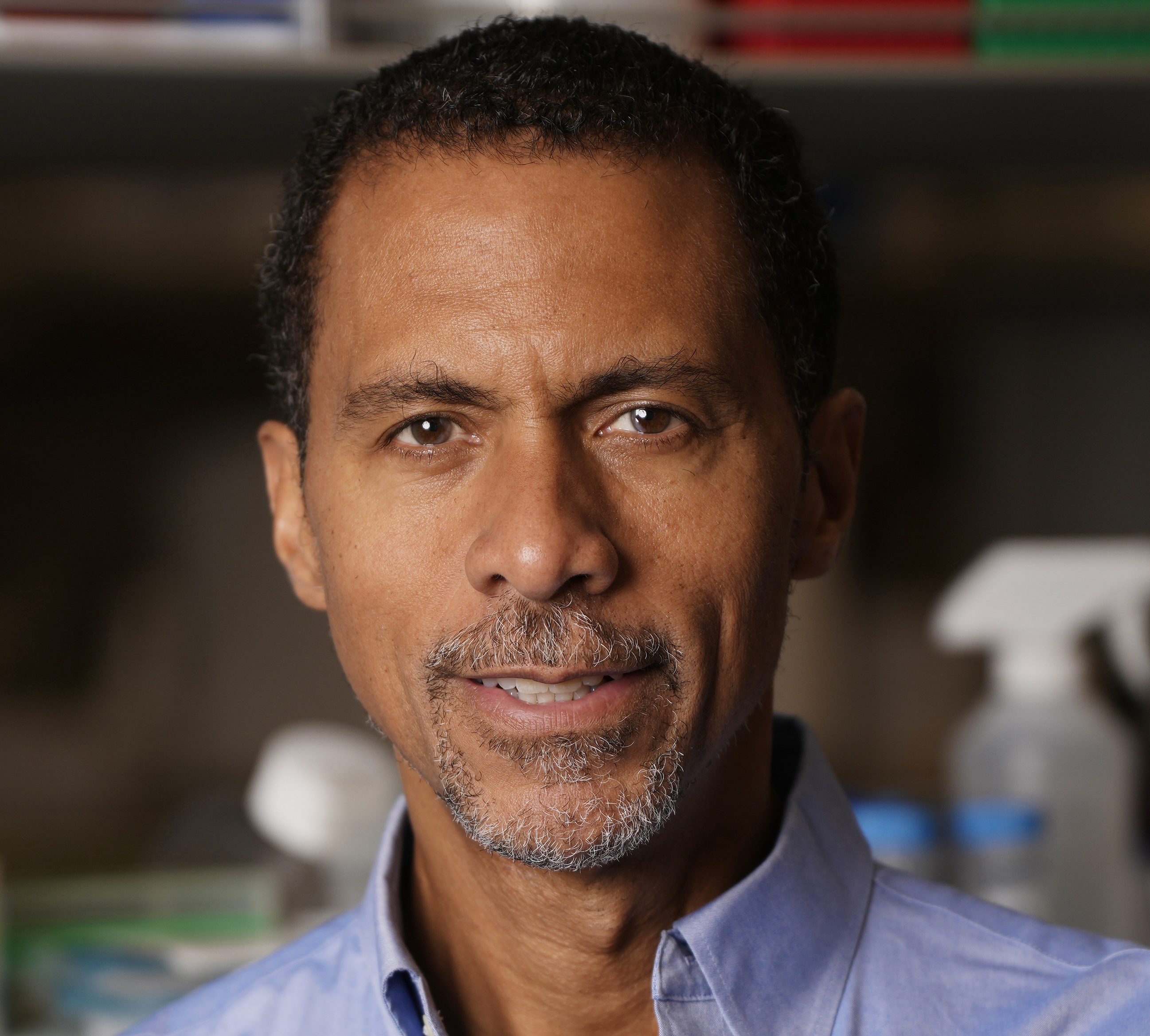
Erich D. Jarvis, Ph.D., an alumnus of The Rockefeller University, returned to campus in 2016 as a tenured professor heading the new Laboratory of Neurogenetics of Language. Dr. Jarvis investigates vocal learning in songbirds and other animals as a model for understanding spoken language in humans. He integrates computational, behavioral, physiological, and molecular techniques to explore the neural genetics of vocal learning and the evolution of this complex behavior. His research has led him to theorize that the brain pathways for vocal learning in both birds and humans likely evolved from a motor circuit common to all vertebrates.
Born and raised in New York City, Dr. Jarvis received a bachelor’s degree in biology and mathematics from Hunter College. He earned his Rockefeller doctorate in 1995 for research conducted in the laboratory of Fernando Nottebohm, where he studied genes linked to vocalization in canaries. In 1998, he joined Duke University, where he ascended to a full professorship before coming back to Rockefeller.
An Investigator of the Howard Hughes Medical Institute since 2008, Dr. Jarvis is the recipient of numerous awards, including the National Science Foundation’s Alan T. Waterman Award, an NIH Director’s Pioneer Award, the 2015 Ernest Everett Just Award from the American Society for Cell Biology, and a 2019 NIH Director’s Transformative Research Award. He is also a member of the Hunter College Alumni Hall of Fame.