
Join BirdNote tomorrow, November 30th!
Illustrator David Sibley and actor H. Jon Benjamin will face off in the bird illustration battle of the century during BirdNote's Year-end Celebration and Auction!
Biomimicry, Birds and Beyond with adrienne maree brown
Bring Birds Back Season 7: Episode 1

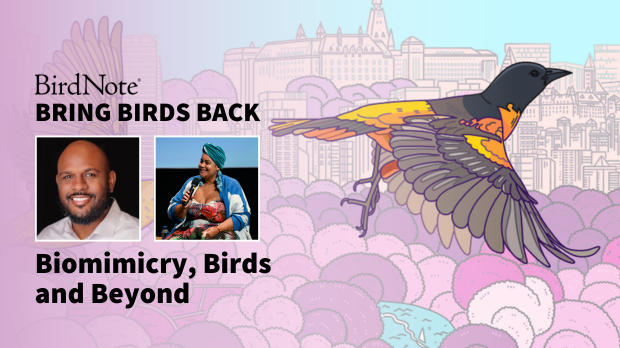
On this season premiere episode, meet your new co-host, Billy Almon! Billy is an astrobiofuturist (which you’ll hear more about later), and one of his passions and expertise is in the art of biomimicry. Billy lays out the history of this ancient process, how it's been instrumental in connecting birds to technology, and how he uses it in his own work. Later, he’ll speak with writer, activist and social justice facilitator adrienne maree brown! adrienne walks us through the unique way she utilizes biomimicry, as explained in their book, Emergent Strategy: Shaping Change, Changing Worlds. Diving deeper into the power of fractals as a biomimetic example, we explore its connection to the natural world and how it can guide us through pivotal life upheavals. You won’t want to miss this one!
Want more Bring Birds Back? Subscribe to our show and follow us on Instagram @BringBirdsBack! For more about BirdNote, sign up for our weekly newsletter. And for ad-free listening and other perks, sign up for BirdNote+ here.
For more information about how to get involved with our From Love to Action campaign, visit this page.
BirdNote is a nonprofit. Your tax-deductible gift makes these shows possible.
Bring Birds Back Season 7 is sponsored by the Cornell Lab of Ornithology and Bird Academy.
[Bring Birds Back Stinger]
Anika Hazra: BirdNote Presents.
[music starts]
Anika: Welcome to Season 7 of Bring Birds Back. My name is Anika Hazra and I’m one of two co-hosts this season.
As long-affirmed supporters of our feathered friends in the sky, it’s crucial to recognize that science is the leading reason so many of us are aware of what’s truly at stake for birds. If it weren’t for the countless researchers, observers, analysts, experimenters and communicators over decades and even centuries in science– our show would be null and void, and so would our ability to effectively save the birds.
This season, we’re still featuring guests doing critical work for birds and for our world at large. But we’re also going a step further by exploring what it takes to be a scientist, activist or both: on the frontlines, behind the microscopes and even on the written page. As a science communicator based out of Canada, I have my own experience to bring to the forefront. But we’ll get into that next time.
For now, I want to introduce you to my co-host who’s also our first guest this episode: Billy Almon! Billy is an astrobiofuturist and today he’s teaching us about one of his favorite areas of expertise: biomimicry! What’s biomimicry, you say? Well, have you ever been inspired by a nearby bird? Perhaps you woke up to a beautiful bird’s tune and were inspired to write a song of your own. Now, think of that influence– times ten! If you’ve ever sat on Japan’s famous bullet train, used velcro on clothing or an accessory, or simply looked beyond the wing of an airplane– you, too, have benefitted from innovators inspired by birds and nature.
That process, when someone designs a material, structure or system that imitates aspects of biology, is called biomimicry– and it’s used by various people for a multitude of reasons, from engineering to ecology. It’s an ancient approach to problem solving that continues to yield modern innovations– and this episode is all about it.
Later, Billy will dive deeper into the topic with our second guest this episode, adrienne maree brown. adrienne is a New York Times-bestselling author, activist and social justice facilitator revered for their socio-political and justice-driven work, some of which has been birthed from their biomimetic studies.
But first, Billy will be walking us through the needs-to-know about the history of biomimicry, its purpose and more– from a scientific and practical lens.
[music transition]
Anika: Billy, it's great to get to know you as my co-host this season. So can you start us off by first introducing yourself and sharing a bit about your background?
Billy Almon: Yes, Anika, likewise!– I am an astrobiofuturist, which is this interesting niche of work that intersects space exploration, this idea of biomimicry - which I know we'll talk more about - and the idea of futurism through the lens of, uh, human connection design. And how do we connect humans to each other, humans to nature, and how do we use empathy as a design tool to build better and brighter futures?
Anika: That sounds great. Okay. Before we get into biomimicry first, uh, let's dig a little bit into your history. So you started out starting architecture at Howard University, is that right
Billy: Yes, HU! I went to Howard. And I came across the idea of architecture and realized that it had so many other subject matters that I was interested in, from, you know, art design, history and politics, and psychology.
Anika: Billy earned his Bachelor of Architecture degree from Howard University in Washington, DC and his Master of Science in Biomimicry from Arizona State University. But it was his profound experience as an undergrad that impacted his trajectory the most.
Billy: While I was there in 2006, the aftermath of Hurricane Katrina, myself and 500 other students from our university– we, we got on buses during our spring break and we drove down to the Gulf Coast and just volunteered. At that time I was in my third year of architecture; relatively far along in my understanding of how to design and build, you know, built environments. And so seeing the devastation, particularly in the Lower Ninth Ward up close– it, it was jarring, to say the least.
And it was one of the most emotional, you know, experiences I've ever had in my life. It left me with a lot of emotions; Why does this kind of thing seem to happen in, you know, low income communities? Why does this kind of thing seem to happen in communities of color?
Going back to school and trying to find answers for those questions, and trying to channel the anger and the sadness that I was feeling into something that actually led me to coming across this idea of biomimicry.
Anika: And in preparing your undergraduate thesis, what were you attempting to find or explore?
Billy: The big question I was trying to answer was this idea of, okay, all of the research I'm seeing around climate change is saying that it's only going to become more impactful and more present and more dynamic and more intense. So if that's the case, a lot of people aren't going to just migrate, you know. And so how do we make houses and buildings and communities more adaptive to all of the changes that are coming.
Like is there a way to make a building robotic so that, you know, parts of the building itself can shift to the environment? And that's when I started researching and came across things like red mangrove trees and how, you know, they're notorious for breaking up the waves of tidal flooding and things like that. And, and then in the research, that's where I came across the idea of biomimetics as a- a bio-inspired design approach. And I just went down that rabbit hole and just completely fell in love with it.
Anika: That's amazing. All right, so, we've been talking about biomimicry for a while now. I think we should define the term for our audience.
[music starts]
Billy: Yeah, so biomimicry is a term popularized by an author and biologist named Janine Benyus, the name comes from the Greek; uh, “bios” meaning life and “mimesis” meaning to imitate. And so, it’s an approach to problem solving and innovation and design where we are imitating what nature has already created. And it's this idea of turning to nature for solutions, given the fact that, you know, life on this planet has existed for, you know, 3.8 plus billion years.
There's a lot of failures and successes that the natural world has experienced over that period of time. And given that everything on this planet experiences the same kinds of conditions, right? Sunlight, water, gravity, um, you know, ebbs and flows of resources, competition, all of these things, all living things have had to come up with solutions to address. And based on that, there's a lot of strategies that exist that we are yet to tap into. And so biomimicry is this idea of us studying the ways that nature and biology have gone about solving different challenges and imbuing our human designs with those strategies; to (one) make them inherently more sustainable; but (two), to also make them more honed in, and in a lot of instances, more innovative.
Anika: Okay. Based on what you just said, it seems like biomimicry is a pretty intuitive concept, but at the same time it feels very novel. Uh, do you have an idea of what the origins of biomimicry are?
Billy: What we in the biomimicry design community always acknowledge is that this is an ancestral, indigenous, and ancient practice that we as humans have been doing since time immemorial. You know, nature was our first teacher. Um, and there's so many different examples of that: Inuit Alaskans were, you know, studying polar bears from afar and watching how they would hunt seal by sneaking up to these little holes where the seals would poke their nose out of the ice and attack them at those breathing holes. And then, the Inuit would mimic that same strategy, right?
So, so this practice is something that has been with us and is probably the first teacher that we've had, ever. And now we're in this really interesting period of time where, you know, more and more people are starting to realize that, you know, in a lot of ways the Indigenous, uh, had it right all along.
Anika: Can you tell us how you personally integrate biomimetic practices into your own work?
Billy: It is the core of the work that I do. For all projects, there's really three things that I'm- I'm looking for. It’s (one), how did nature solve this problem? (Two), is there an opportunity to make whatever this solution is, something that's more complimentary to the natural world? And then three, is this an opportunity to connect people to nature in a way that they, for whatever reason, um, have not had a connection to, right?
Like, from a psychological programming perspective, people often have a particular relationship that they've had over time with the natural world, right? Oh, bugs, ugly, horrible. Stay away. Stomp. Stomp. Right? Part of my work is helping you see that it's not just a bug. It's actually this really cool collection of technologies that we call sensors and organs and muscles and tissues. That if we look at it through the lens of design and innovation, there's a lot of things that we still have so much to learn about.
Anika: Can you give us some concrete examples of issues that biomimicry would be best suited to solve?
Billy: The airplane, right? That- that's an example of mimicry of form. So, the Wright brothers, they actually studied turkey vultures and the aerodynamics of their wings, as they were working on their first iterations of the airplane.
Anika to listeners: Billy’s correct. The Wright Brothers were initially inspired by Otto Lilienthal, author of the book, “Birdflight as the Basis for Aviation.” Otto died in 1896, due to injuries, following a crash on his glider[1]. Carrying on his biomimetic approach to the wing warping, Orville and Wilbur Wright observed turkey vultures twisting and alternating their wingtips - one upward and one downward - in order to maintain balance in the sky.[2] And one fateful day in a bicycle shop, Wilbur found the missing piece of their long-unraveling puzzle.
Billy: There's other examples where researchers have been studying how fruit flies process information in order to develop new algorithms around search engines because of the way that the fruit fly brain clusters information and processes it. So the- the range of biomimicry is super broad. So another kind of, more basic example, is Velcro. Velcro was invented by a Swiss inventor who would take his dog for walks through the forest and he would notice that his dog would always be covered in these spherical burr seeds that had these curly q little hooks on the end of it.
And when he took it under a microscope and he saw that, these hooks, there was no adhesion, there was no glue or anything like that. It was just these little curly q little hooks that were attaching to the follicles of hair on the dog. He said, this is a really great way to attach things. So from that, he developed Velcro by mimicking or copying that same approach in the form and the shape of the Velcro individual strands.
And the reason why it has those curly q little hooks is so that it could attach to the fur of animals going through the forest in order to, essentially, catch an Uber ride to a, a location that would be more ideal for the seed to eventually fall off and sprout into another plant and tree, which is dope to me. So, the gamut is so widespread in terms of the applications that are waiting for us to discover solutions in the natural world to problems in the real world.
Anika: Do you know if there is any actual research that confirms that biomimicry based technologies are as effective or maybe even more effective than other types of technologies
[music selection]
Billy: I think there's definitely an aggregate of research that confirms that natural solutions can lead to more efficient outcomes. So, in Japan, there exists a particular location where the bullet train that passes through this countryside region has had a lot of different issues. One of the biggest of them being that whenever it would go through a tunnel, it would create this large sonic boom. And it was frustrating to a lot of the people who lived in that region. And so, there was an engineer that was tasked with coming up with a way to eliminate the sonic boom. It turns out he was also a bird watching enthusiast.
Anika: It was the 1990s, his name was Eiji Nakatsu and he led the technical development of the project.
Billy: One day while he was bird watching, he came across this bird known as the kingfisher.
[Common Kingfisher call]
And now, kingfishers have these really elongated beaks, they taper down into a point. And he saw this kingfisher dive into the water to capture a fish below the surface and he noticed that there was virtually no splash. And the design of the kingfisher's beak became the inspiration for the new design of the high speed rail train.
And what wound up happening was not only did it get rid of the sonic boom as a result of that, but I believe there was also a 30% increase in fuel efficiency as a result of it. And so in the natural world where resources are not a given, efficiency is the way to, to thrive and be sustainable. So you're looking at these solutions that exist in the natural world, that are built on the idea that these organisms have to be efficient.
Anika: I think you've been alluding to this, but would you say that biomimicry is the future of sustainable technological innovation?
Billy: Yes. I believe nature is the future of everything. I believe that, because of climate change, our holistic sensitivity to nature is growing. The tools are only getting sharper and there's so many wonders that we are just constantly on a daily basis being exposed to.
In that, we start to see just how beautifully complex a lot of the simple things that work in the natural world are, at the same point where we need more nature to balance out what we have stripped up and what we have decimated and, and got rid of.
Nature is full of community, right? A lot of the times where we see something that involves creatures and organisms that we see as magical, that takes place in the natural world, what we're actually seeing is community. Like that magic that we're observing is a community that is performing some action before our eyes, right? So fireflies come to mind. Bird murmuration, you know, all of these thousands of birds doing this aerial dance and none of them colliding. Like those are community practices that look like magic to us. And I think biomimicry is that bridge.
[music selection]
Anika: Thank you so much, Billy. This was a very inspirational discussion. I’m so glad that you mentioned nature as belonging to our community because the essence of biomimicry really is that connection to nature – our ability to observe it, learn from it and better ourselves and our world. And our next guest really speaks to that concept in a special way.
Billy: Very much so, Anika. Our next guest, adrienne maree brown, merges the practice of biomimicry into their work, alongside the concept of emergence strategy, which she refers to quite often throughout our interview. This emergence framework makes sense of complex systems by first understanding the smaller, less substantial and potentially chaotic events that led to the system’s complexity. Like biomimicry, their approach is rooted in understanding those complexities and applying them to daily life.
Billy to adrienne: adrienne! Thank you for being here. Can you introduce yourself and your work to our audience?
adrienne maree brown: So, my name is adrienne maree brown and I am a writer and I spent about 25 years inside of social justice and environmental justice work; as a facilitator, as a movement leader. So a lot of my writing is really informed by what I learned, holding groups of people trying to create change in the world. And I learned there's some, like, large patterns of human behavior that are actually in our nature that I was and am interested in how we harness ourselves as a function of nature, how we learn from the nature all around us. So, a lot of my work is around emergent strategy; this idea that change is the constant and anything that we're doing has to be learning how to be in right relationship to change.
Billy: I lo- I love that. And as someone who refers to his work as dream farming, can you talk about what being a gardener of ideas means for you and how it informs your work?
adrienne: It's interesting. I was torn between a gardener or a doula, but I think both do the same thing in a way, which is, there's natural processes that are happening in the world. And then there's a way of figuring out how do I partner with those practices, steward as needed, care for those practices, and help encourage the best possible natural outcome to occur, for mutual relationship, right? So, when I think about the gardening of ideas, I get very literal with it, right? I am like, oh, every opportunity I get, I have to be casting my seed out. And that I don't know where the fertile soil is gonna be, but history shows us that there is almost always some place, some pocket of fertility where life continues and where new things emerge.
I believe that our purpose here is to love it and to care for it, and to be cared for by it, and care for each other and be cared for by each other. So I'm throwing these seeds out into the world. And then the seeds are these beautiful things that someone gifted to me that at some point I was the fertile soil. And someone was like, have you heard about emergence? Do you understand biomimicry? Do you know that the world moves in these cycles? Have you understood that there's patterns that repeat themselves at scale from the very smallest thing to the largest thing? So I think about these things and I'm like, okay, so the seeds of all of those ideas, they landed in me and took root. I didn't start it, but something grew and now I'm casting it out.
Billy: I love that so much. And, you know, that transfer of seeds that you talked about, I think is a lot of the work right now. You've talked about, in your personal practice, you've used decades of work with movement facilitation, somatics, science fiction scholarship, and as you just mentioned, doula work, to inform your practices for transformation. Can you share how these lived experiences that you were also just referencing, led you to the world of biomimicry specifically?
adrienne: I will say, first of all, that I was raised by two people who didn't quite fit into the world that they were born into and found each other. And they were like, we are gonna make a new way; we're gonna make something else. And so growing up, I always was paying attention to that. From a very early age, my dad was a military man and so we moved every two to three years. You land in a new place and you have to form community and friends and everything again. So, at least for some of us, nature becomes the place where we're like, “okay, I have a friend that's a tree!”
Like I'm tuning into the natural environment around me and you start to learn to look at the world as like, oh, there's so many beautiful ways to exist. So, then, once I started doing movement work, um, I was frustrated with what we were doing. I felt like we had gotten really caught in, like, competing with each other over everything. Monetizing everything, even the work that we were trying to do for social change. And I was like, I thought I came here to work with people. We're not doing that. We're not connected to each other. We're competing.
So I'd been in New York, I had been in the Bay, and then I started seeing someone in Detroit and fell in love with the city. And even when the relationship ended, I was like, I'm mad about this city.
[music selection]
adrienne: That it was like, we are making a way out of no way. Like all the auto industries, all the capitalism just pulled itself out of that city. And somehow some people survived by gardening, by creating their own justice processes that happen in their community because they were like, ‘there's no police or fire people coming when we call. We're gonna have to figure this out ourselves.’ And I landed about three decades after the most intense period of that economic crisis. And so I got to see the systems having developed for some time and I got humbled. And so one of the teachers in that work was Grace Lee Boggs[3]. And Grace Lee Boggs was a Chinese American activist and scholar who lived in Detroit. And she started geeking out about emergence. She connected us to the work of Margaret Wheatley and she had Margaret Wheatley actually come to Detroit to talk with us. Margaret Wheatley had written a book called, “Leadership in the New Sciences.”
And so a whole circle of us started geeking out and being like, what is emergent science? What are fractals? What is this quantum aspect of this? What is the complexity that is good and what are the nuances between us? Emergence, for me, really sung as an idea. The idea that, through relatively simple interactions, these complex systems and patterns emerge, and that that's how all of history came into existence. And I was like, okay, if we understand that as a building block of how we be, how could we work with that to change how we are?
Can we be dandelions? Are we supposed to be the seeds that got tucked into our ancestors' hair? Like what is the lesson that nature has for how we move through this? Are we actually the seed that's only gonna burst because there's a wildfire?
And I try to really work with nature, both as metaphor and as teacher. So it's like there's a poetic aspect of it that I think helps us understand ourselves. And then there's the science of it, which I think shows us who we are.
[music starts]
Billy: Hold that thought! Right after these messages, we’ll return with adrienne maree brown and dive deeper into the concept of “emergent strategy” as it relates to biomimicry, the acclaimed book she wrote about it, and how it’s changed their approach to not only work, but everyday life... Plus, some words of advice about how you can implement it into your own daily routine. Bring Birds Back will be right back.
MIDROLL with season 7 sponsors
Billy to listeners: And we’re back, talking with writer, biomimicry practitioner and social justice facilitator (among many other things), adrienne maree brown. One thing I love about Adrienne's work is how it illustrates what can result from turning to nature for inspiration and insight on building a better world. In their book, titled Emergent Strategy, adrienne demonstrates patterns in how nature works —how birds flock, fungi connect, and cells collaborate. She uses these patterns to guide how we build communities and movements that are adaptable, decentralized, and rooted in relationships.
Billy to adrienne: Your book, “Emergent Strategy: Shaping Change and Changing Worlds” does a really great job of illustrating the powerful insights that nature can teach us. Everything about re-imagining systems and particularly as it relates to activism and activist movements. Can you share some more about what turning to nature for informed solutions can teach us?
adrienne: One thing I can talk about is interdependence because, I will say this, I'm comfortable being out of my depth and being kind of like, ‘this is all more than I can truly comprehend, but I'm really enjoying what I can grasp.’ And I feel like that when it comes to biomimicry, that I'm like, I just beginning to understand just how alive everything actually is and how connected everything actually is. So lately I've been driving around and getting moved to tears by, like, looking at the trees around me and recognizing like, “Oh, you're older than me,” which means you knew some of my ancestors. There's a relationship and actually maybe some of you are my ancestors because my ancestors were buried at your feet or in your roots or in the Earth that fed you.
Then I bring back into the work of creating change with other people. And I'm like, okay, we are so much alike and we are so connected. Can we even handle that, right? Because we've been trained to focus on how we are different. And so, one of my favorite things that happens in the natural world - that we are also a part of - is when there is a crisis of some sort amongst humans and humans have to leave an area, the quickness with which the earth comes and it's like, “Okay, great, we'll take this back now. We're gonna make use of everything that you left here, and we will barnacle it under the water or we will grow a tree through the center of it.”
And I think that the disconnection is what keeps us powerless. The connection is what makes us powerful. Like, can we trust the trees and the mushrooms? 'Cause they're really good at communicating warnings and sharing food. I don't know if you've seen this, but there's this woman on the internet who goes up to trees and she's like, “come to the sound of my voice.” And the tree comes and the tree touches her. And so I've done that experiment now multiple times, like I was talking to the tree in my backyard, like, “Could you talk to a tree in Palestine, like an olive tree there?
Could you send my nourishment and my love and water? And could I send safety and like, what could I do?” I believe it is possible because this is a living Earth to be in a sentient relationship with it, all of that feels exciting to me. I then also come back to like, if we're trying to build something different in this world, how do we build it with the world? How is the process of creating change one that gets your bare feet on the dirt, you know? And I'm in those practices myself. The more interdependent and interconnected I am, the less I feel urgency in crisis.
Billy: What I love about that is, so much of this world is built on, in my opinion, misconceptions we have about the natural world. And, one of the biggest ones the idea that there's more competition in nature than there actually is mutualistic and beneficial relationships.
And the fact that the quote, “Only the strongest survive,” is so, you know, misquoted.
adrienne: It’s misunderstood.
Billy: Yes. And it's really about you and your niche of quirkiness finding the environment that is most conducive to you thriving. Which is really about biodiversity and, by extension, diversity. It's also interesting and sad how the fight is really against the very thing that we need right now.
adrienne: Oh, and it makes us so foolish. You know, it's like what is not clicking here? Like there's one planet. It is the source of every aspect of our lives. It's the only thing that we know, and we've been looking, we've been searching, but we haven't found anywhere that we could get to or any way we could get there that does what this planet does.
My strategy is like, how do I create as many delicious pockets of existence as possible where people are like, oh, it's, it could be that easy to just be in relationship with the Earth?
Billy: This feels like a great opportunity to introduce fractals into the conversation. In talking about your work and about this idea of "emergence," there's one thing that keeps coming up that I'd love for us to spend a little bit more time exploring, and that is the power of fractals. So, fractals, for listeners who may be unfamiliar, are a never-ending pattern, it’s a pattern that repeats itself, on any scale. Like looking under a microscope at close range and then zooming out to a wider view– and the patterns look the same. They’re found throughout nature, in all kinds of things from leaflets to crystals to snowflakes. And what I appreciate most about what you share, adrienne, as it pertains to fractals, is how the idea of fractals can make really big, seemingly impossible tasks and challenges feel manageable and less intimidating. Can you define what you mean by fractals in this context to nature and how you came to find fractals as a potential solution?
adrienne: So, the first thing I came across was the Fibonacci sequence and I was like watching this and being like, oh, patterns exist in the world that can move all the way to the very smallest thing beyond our imagination and all the way to the largest. And the pattern is self same repeating. And that no matter what scale you're at, you're seeing the same pattern. And I loved that idea and I started tuning into it and being like, oh. Where are the fractals that I can see? Where are the fractals that I can understand? There's also fractals in the systems between us and the Earth. So, looking down from above at a delta and then looking at the way our arteries and veins move the resource of blood through our bodies, and that means they're moving the resource of oxygen and life.
Everything that we need is moving through us the same way water moves through the dirt. I was like, okay, so that's also a fractal. And then this spiral fractal, you know, I was like, if I look at the tip of my finger, then I'm seeing the same shape as the galaxy that I'm a part of.
I got very excited about the idea that then we could be fractals, right? That like each little human was like a cellular fractal of something and like, what is the larger thing that we're all a part of, right? And so then I started being like, okay, if we understand a fractal pattern, how do you change something?
I had been a part of a lot of campaigns that were trying to change things from a top down place that we're like, if you just come in and if we just change the president, it's gonna be so good. After that, we're gonna have justice, liberation, freedom, and joy and yams. And so then, when we changed the president, and it was like, oh, that's not how this system works; You have to go down much smaller than the presidency to impact this pattern. You have to be willing to go down to a school board, go down- who's the sheriff and who's on the city council and yeah, who shows up to these meetings and helps make decisions.
Like, oh, democracy would have to be one of these fractals and we would have to figure out where along the small scale we could start to create change that would actually then have to ripple into the pattern and create a new pattern of us. What I think we see is, is white supremacy is also a fractal pattern. And we watched it unfold and become a massive thing that feels like it could never change, but it has changed before. It wasn't this way five years ago, it wasn't this way 10 years ago. Um, it's been better. It's been worse. And so this is not a permanent situation. And that's the other part of fractals. There's something that feels hopeful to me about the fact that fractal is a way that we can create these changes and that we can claim the positivity of the temporary nature of ourselves and of our patterns, right?
Whatever thing we are a part of, as many of us as possible have to tip our way back towards justice and liberation and relationship, I think.
Billy: The most visual representation of what I've seen taking place right now is actually coral bleaching,
adrienne: Mm-hmm.
Billy: Where you literally have these organisms who create a structure and when it's healthiest, there is a diversity of colors that exists.
adrienne: It’s every color. It's the most beautiful thing in the world.
Billy: It’s symbiotic and with coral bleaching, it's the expulsion of all of the things that create this color and vibrancy. And then all you're left with is this skeletal institution that has none of that color and is also starting to die because of that expulsion, right?
adrienne: What's a better metaphor for white supremacy than that?
Billy: I mean, that's right. It's the most visual example in nature that I've seen of what's taking place. But I do think that idea of the fractal responsibility and being a fractal of belonging and being a fractal of change really is a big part of the solution of how we fix that.
adrienne: Well, this piece about responsibility, I think, it gets me excited again about the idea, right? When I am looking at the world and I get overwhelmed, I'm like, “no, it's too many crises, it's too big, there's too much happening,” and then I won't do anything.
But as soon as I tune back into the fractal responsibility where I'm like, how do I figure out what I can do that I actually will do, that I believe will have some impact? And pull myself away from the theoretical, ‘somebody should do something.’ In a fractal responsibility, it's like, I am responsible for something, what is it? Let me find my lane, let me occupy it.
Then the fractal belonging piece, I'm like, I already belong to this pattern. And you can stop anywhere along the pattern to figure this out. Like, I already belong to the Earth because gravity holds onto me every day. The fractal belonging is shown by how the world offers up food, offers up water. So, I can also apply that in my community. I can apply that in my family. I can apply that to my friend groups. This is important because right now, I think so many of the ways we're kept from being powerful are in the ways we're made to think that we don't belong anywhere.
So fractal belonging is a reminder like, I already belong to the whole Earth. Anywhere I land, I am the dandelion. I will create community. I will create life. I will find a way. Now, if I can set to the side that I already belong, what is it I want to belong to? And this is where the fractal change comes in. It's like there are aspects of things as they are that I love. But there are a lot of things I wanna change: justice, liberation.
We have not figured out how to have those be available to the majority of people who already belong to the Earth. Who already have the right to these things. So then fractal change, I think of the sparrows. I think of the songbirds. I think of the geese. I think of how birds move together and I'm like in a system of birds moving together, flocking together, you witness this relationality of change, right? It says we are all gonna start moving in a different direction together. We're all gonna go this way. And the rules of how they practice are something I think we can learn from, which is, ‘I have to pay attention to the birds right around me. It's not gonna help me if my attention is like on [a] bird way over there on the outside of the pattern.’
I'm not close enough to see what's happening with them. I'm close enough to the 6, 7 birds right around me to actually feel and see exactly when they start to change. If I trust, I can follow and we can start to move together, but I can't be too close to them either. I have to make sure I can fly, so I can move, but I can't be too far away either or I become part of a different flock, right? That's how I think humans also have to function and especially in a time like this. Find your pod, your core of people and say, what are we gonna change together?
It’s not enough to just do it by myself. So those are some of the ways I see fractal responsibility, belonging, and change.
Billy: Oh my gosh. What I love about everything that you just said was it reminds me of something that you talk about in Emergent Strategies, which is this idea that, ‘small is good, small is all...
adrienne: Yeah. The full line is, “small is good, small is all, the largest, a reflection of the small” or “the largest, an outcome of the small”. And I think about this because a lot of the ways people here, they're like, oh, so we're just supposed to do like tiny little stuff that doesn't even mean anything? I get that reaction from organizers I trust who are like, this is a large scale problem that needs large scale solutions. And I'm like, we're not saying different things, right? Everything large that is terrifying us. Everything large that is overwhelming us is made up of small things.
It is made up of small decisions. It is made up of relationships between people. It is made up of compromises. It is made up of people getting small in the face of a challenge, right?
One of the coolest things about human history is that we almost never have 3 billion people doing anything at the same time. We almost always have very small groups of people who are willing to be loud and outrageous and say, I'm willing to risk my comfort to make a change, for the sake of a liberated reality.
Like, let me have a conversation with someone at a dinner table. Let me call somebody who I care about, who I think is losing touch with their humanity around this. Um, let me challenge the, the instinct to “other” something. That work is slower, it's a little longer. But you build authentic connections between people. We live in a world where, like, our whole human history is made up of humans changing things. Everyday, Harriet Tubman's name is in my mouth. And she didn't know when she was living her small life and saying, I'm gonna take one person at a time, a small handful of people at a time. I'm gonna ask them to trust me, even though I just had an epileptic episode. Even though I'm, like, listening to God and telling them to follow a star. I dreamt that we were free and I'm gonna just ask them to follow me.
All of those things, I'm sure, felt so small at the time; terrifying; like life changing, but also, like, not enough: small. And yet now, anytime I wanna talk about freedom and like the work of liberating other people, I have to speak her name. But there's so many others. And we are of this time and it feels overwhelming, but like, we are the ones who will decide what kind of apocalypse it is and where we go from here.
Billy: I think history has a way of calling on names when time needs it. So, the names that are being invoked now, that idea of Sankofa, you know, going back and getting what we need.
adrienne: Yes, looking back to look forward.
Billy: There's so much that we're pulling forward right now. There's a quote that's attributed to Mark Twain that talks about, “history does not repeat itself, but it does rhyme.” And we're definitely rhyming with some past moments right now.
adrienne: Moments that never really got handled. There's a book I did, a collaboration with Walidah Imarisha, that's called, “Octavia’s Brood”. And one of the things that we touched into there was this idea that we are living inside of the imaginations of other people; that we are not living in a world where it's natural to have white supremacy or male supremacy, or able-bodied supremacy, or just a norm, right?
Like we are a bio divergent species. And someone imagined supremacy into that. The idea that we're living inside of someone else's imagination, I think when you first grapple with it, it can make you feel quite claustrophobic. And then all of a sudden it's like, wait, ‘Okay, so someone imagined it…’ And then it becomes our responsibility to imagine something else. It becomes our liberation pathway to imagine something else. Can you imagine a life that felt meaningful where you weren't just giving your time to something for money and then coming home and having a tiny little time for love and creativity and caring for your body and everything else? People have lived that way, on this Earth. Like it's not something that's made up.
I think our work now is to awaken enough imagination and enough people that they could see themselves in a compelling future that is not rooted in oppression and harm, but rooted in interdependence and fractal, beautiful earthling experiences.
Billy: Absolutely incredible. adrienne maree brown. Thank you so much for your insights, your time, and your contribution to this timeline.
[music transition]
adrienne maree brown: Well, thank you. Also, you know, when I met you, I was so geeked out to learn that that there was someone out there who was just as deeply entrenched in this particular strain of geeky, wanting to save the world in this particular way. So, I'm glad that you pulled us into this conversation. And I hope we have a lot more.
Billy: adrienne explores many of the themes discussed in today's conversation in their new book, “Ancestors”-- the final installation of their fiction trilogy, Grievers, which examines how nature and community play a critical role in how we build what comes next.
This episode, we’ve covered so much ground: starting from the origins of biomimicry to the multitude of ways it can be used for innovative progression and even future dreaming. What adrienne’s interview highlighted the most for me is how dependent our future is on our connection to the living world around us and the importance of taking time to, as Albert Einstein once said, "look deep into nature". In order to understand everything better (including ourselves), we must take into account our very first teacher: nature. And of course, I couldn’t have done this without my co-host, Anika.
Anika Hazra: Thank you, Billy. I really enjoyed getting to know more about you and your passion. And the interview with adrienne was more than I could’ve imagined.
We still have so much to learn, but I hope this helped bring everyone one step closer. I certainly learned a lot.
Billy Almon: For those of you curious to learn more about biomimicry and how to start applying it into your own work, check out biomimicry.org. You’ll find that link and more resources on our website: BirdNote.org
Many thanks to the phenomenal adrienne maree brown for expanding our world view on biomimicry and emergence… And, of course, thank you for listening! To learn more about today’s topics and guests, or even to join our From Love to Action Campaign — look for this episode on our website at BirdNote dot org.
And please follow us @ Bring Birds Back on Instagram for the latest updates and behind-the-scenes about the show. This episode of Bring Birds Back was created by our production team, including Fact-checker Ariana Remmel; Producer Josh Fisher; Senior Producer Mark Bramhill; Managing Producer Jazzi Johnson; and Content Director Jonese Franklin.
Our music is by Blue Dot Sessions and Epidemic Sound. And this episode was co-hosted and co-produced by me, Billy Almon. And remember: to change the world– dream boldly, and start where you are. Until next time…
[Music ends]
Post-credit blooper roll
Jonese Franklin
Content Director
Jazzi Johnson
Managing Producer
Mark Bramhill
Senior Producer
Josh Fisher
Producer
Ariana Remmel
Fact Checker
Anika Hazra
Host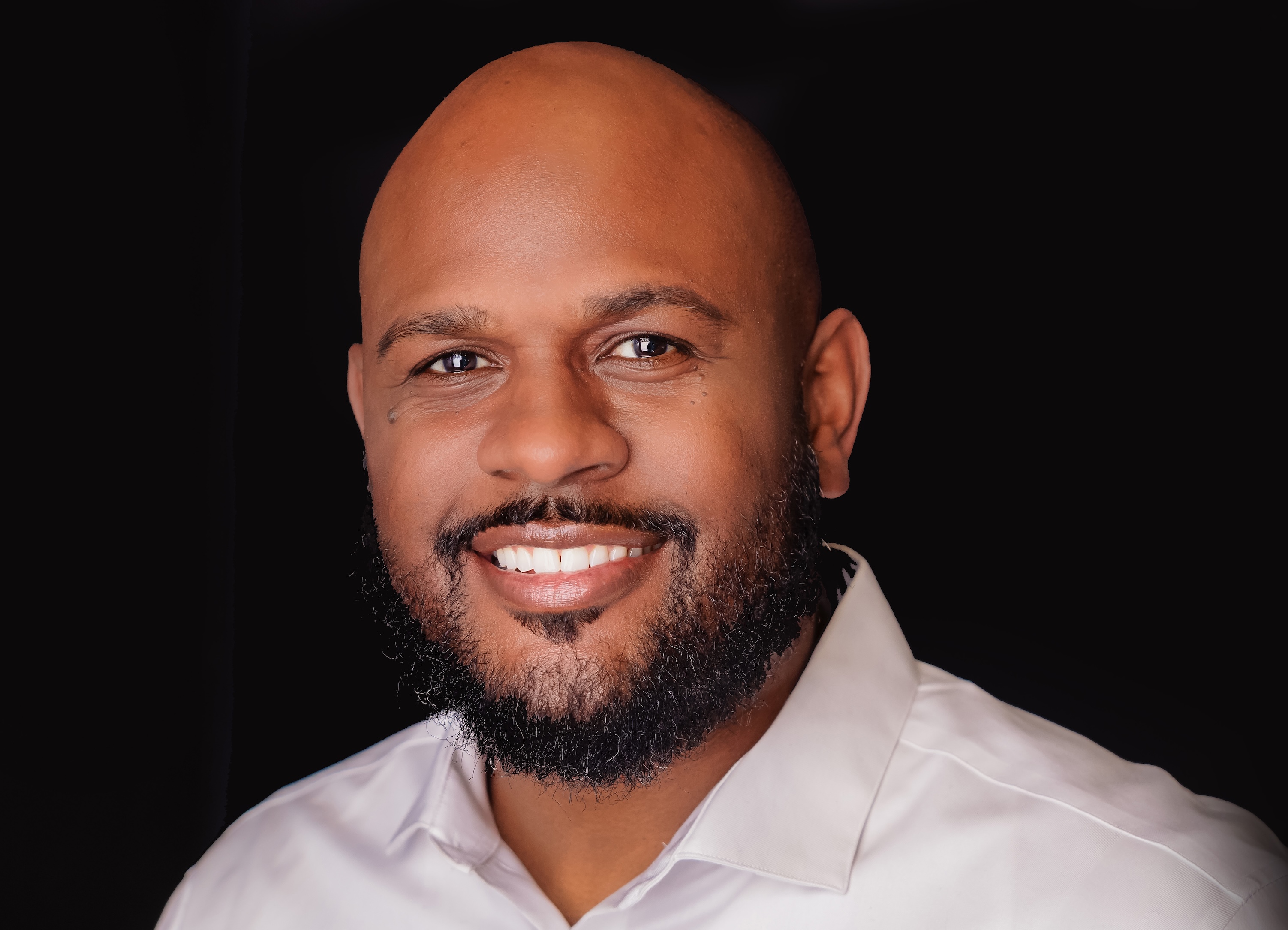
Billy Almon
HostEpidemic Sound
Music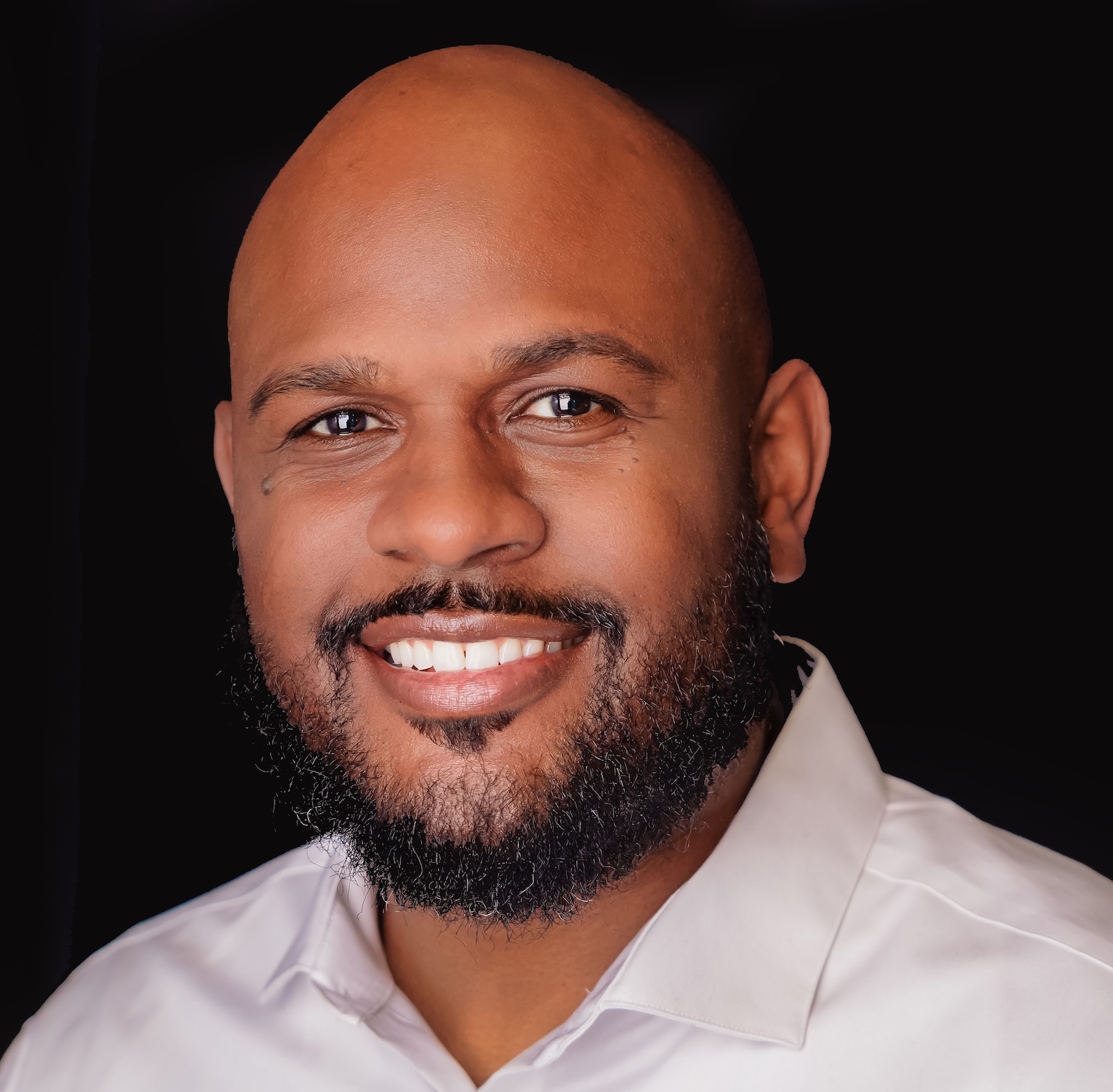
Billy Almon is an astrobiofuturist who uses nature’s hidden wonders to design innovative solutions for Earth and beyond. Through his Dream and Adapt Framework, Billy inspires leaders, educators, and creators to dream boldly, adapt intelligently, and thrive in the uncertainty of dynamic environments by applying biology-inspired strategies to solve society’s complex challenges.
Previously, as a creative director for Walt Disney Imagineering, Billy has designed immersive experiences worldwide. He co-hosts Little Giants on Animal Planet and Discovery Plus, while exploring biomimicry’s role in innovation. An inventor and thought leader, he holds a Master’s in Biomimicry (ASU) and a Bachelor’s in Architecture (Howard University). His work integrates science, storytelling, and psychology to turn bold ideas into practical solutions.
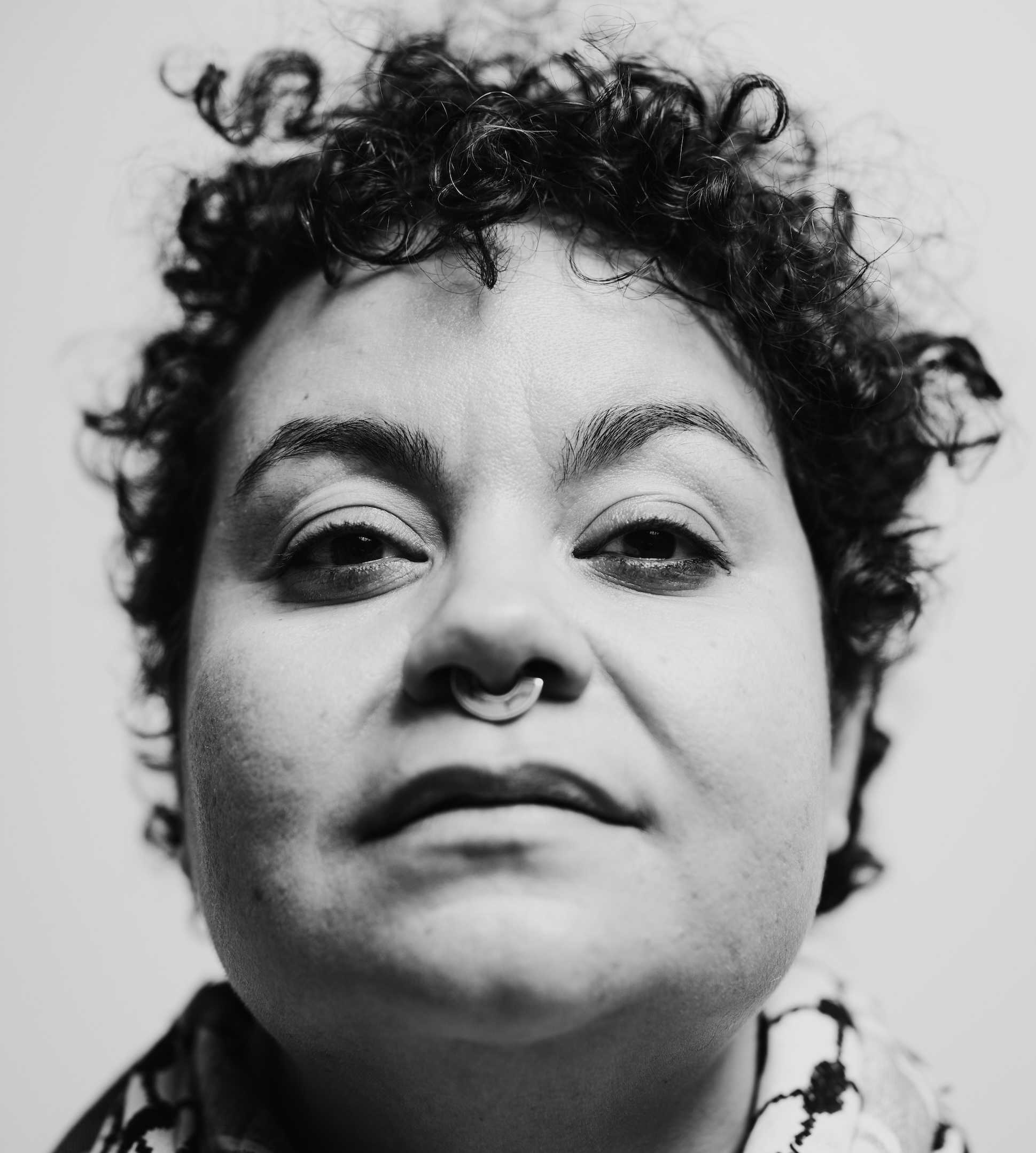
adrienne maree brown (she/they) is growing a garden of healing ideas. Informed by decades of movement facilitation, somatics, science fiction scholarship and doula work, adrienne has nurtured Emergent Strategy, Pleasure Activism, Radical Imagination and Loving Correction as ideas and practices for transformation. adrienne is the NYT-bestselling author/editor of several published texts, a ritual singer-songwriter, co-generator of the Lineages of Change Tarot Deck, and co-creator/host of How to Survive the End of the World podcast with Autumn Brown. adrienne's latest book Loving Corrections is now available from AK Press.